
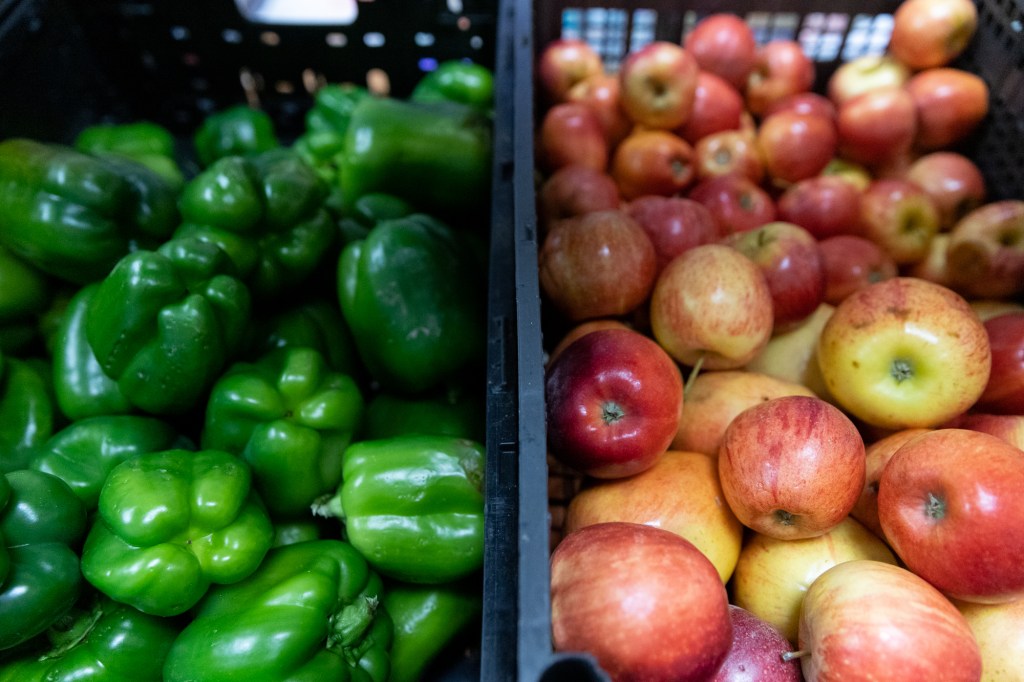
Green peppers and apples in Samaritan House’s pantry in Redwood City on Aug. 28, 2019. Photo by Magali Gauthier.
By Kate Bradshaw
September 9, 2019
When Kendy Mendoza of East Palo Alto and his wife experienced health scares over the last few years, they took action to turn their lives around. Eight years ago, when his wife was diagnosed with diabetes, she cut out bread and tortillas from her diet, he said.
Two years ago, after a heart-related health scare, he added, he changed his diet and exercise habits, and now hikes and eats 70% more fruits and vegetables.
“My life is changing,” he said.
He explained all of this during an interview with The Almanac while he cooked fried chicken in front of St. Francis Church in East Palo Alto to feed the post-service crowd one Sunday because, he acknowledged, it still sells better than vegetables.
As The Almanac discussed in part one of this series, a number of local health clinics are increasingly focused on trying to address the “social determinants” of health, seeking to help people to proactively develop healthy habits that reduce their need for acute medical services.
One of those key determinants of health is diet and access to healthy food, an area in which there are significant differences in access based on neighborhood.
The discrepancy isn’t hard to see: In Palo Alto, Redwood City and Menlo Park, there are four Safeways, two Trader Joes, two Whole Foods, two Grocery Outlets and a number of other specialty and local grocery stores. But head across U.S. 101 and the grocery stores become few and far between, making it harder for residents to access healthy food and impacting the health of that area’s residents.
Read more at paloaltoonline.com.
 Kate Bradshaw
Leave a comment