
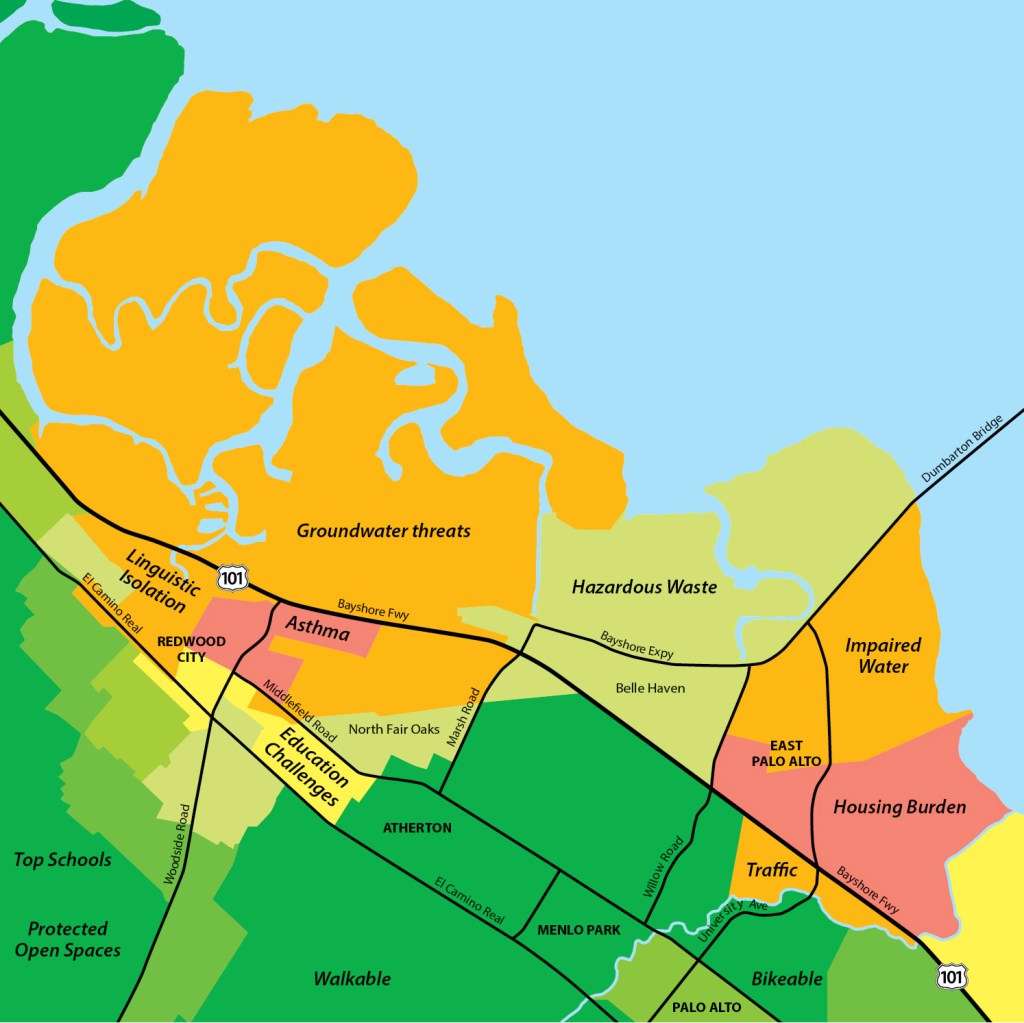
The CalEnviroScreen 3.0 index identifies the environmental health burdens of communities by census tract. Pink indicates a census tract among the 10% with the greatest environmental health burden; dark green is among the 10% with the least environmental burden. The yellow, orange and pink areas share many of the same top burden factors, some of which are listed above.
By Kate Bradshaw
August 27, 2019
The year was 1957, and two women, one white and one black, set out on an undercover investigation in Menlo Park and Palo Alto.
Their task was to investigate the hypothesis that real estate agents were conspiring to sell homes in certain neighborhoods to white people, and homes in certain other neighborhoods to black people.
They developed a plan that would ultimately prove their hypothesis all too correct: The black woman, who was not named in the study, would approach a real estate agent and express interest in purchasing a home in a predominantly white area. Then the white woman, researcher Elaine Johnson, would follow afterward, saying she was interested in buying a home in East Palo Alto or the Belle Haven neighborhood of Menlo Park, whose population had by then become predominantly black. Johnson would play naive, and record what she heard.
Over the course of 19 interviews the duo conducted (these included meetings with real estate agents in San Mateo, San Carlos, Redwood City and Los Altos as well, where similar interactions were reported), the agents nine times explicitly refused to sell the white researcher an East Palo Alto or Belle Haven home, said the area was not desirable, and stated that it was not desirable because the area had African American people living there.
While it’s easy to dismiss this history as a time when laws and attitudes were different, the impacts of these discriminatory actions persist in the health outcomes these neighborhoods experience today.
Research has shown neighborhood racial and ethnic segregation to be associated with adverse impacts on health in areas including cardiovascular risk factors, elevated rates of infectious disease, and premature death. Minorities in segregated communities are also more likely to have limited employment opportunities and lower incomes, as well as to face shortages of safe and affordable housing, all factors that affect health.
San Mateo County Health Officer Dr. Scott Morrow, the county’s top public health official, said the communities of North Fair Oaks, Belle Haven and East Palo Alto tend to light up as red flags on a number of indices when it comes to health problems because of bad health policy – linked with bad housing policy – compounded over generations.
In short, people with the lowest incomes are stuck in the least desirable and most polluted areas, he said. And now, the housing market is stretching those households to their breaking points.
Read more at paloaltoonline.com.
 Kate Bradshaw
Leave a comment