
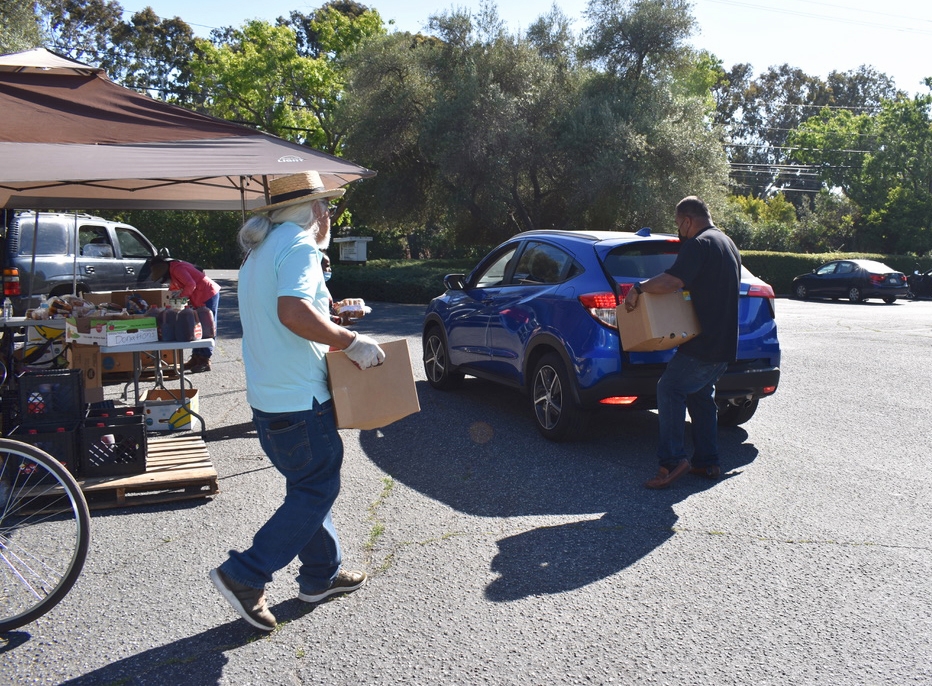
Volunteers help load boxes of food into vehicles after asking drivers how many boxes of food they want on June 4, 2021, at a food distribution site in Palo Alto. Photo by Kate Bradshaw.
How a federal program to help farmers during the pandemic is changing the local food landscape
By Kate Bradshaw
June 11, 2021
Every Friday afternoon from 3 to 6 p.m., the parking lot of St. Andrew’s United Methodist Church on Alma Street in Palo Alto becomes a drive-thru food aid hub.
Last Friday, a team of volunteers that included organizer Rev. Saulisi Kanongata’a and his 9-year-old daughter Moala asked the drivers of vehicles lining up in the parking lot just one question: How many boxes of food do you want?
Under a pop-up canopy there were pallets of food boxes that Kanongata’a said were from the U.S. Department of Agriculture, stacked for distribution alongside additional offerings. Those items, like broccoli, tea, cauliflower, bread and more, were provided through donations from Hunger at Home, a San Jose-based food aid nonprofit, he said. Although the tower of USDA food boxes was still taller than this reporter, he assured me a little after 4 p.m. that, by five minutes to 6 p.m., all of the food would be gone.
To get the word out about the food boxes, he had created a WhatsApp group, posted about the boxes on Nextdoor, and, through a colleague, posted the information on Craigslist, he said. As a result, people had come from as far away as Tracy.
The volunteers stacked boxes into trunks and backseats, loading up recipients with whatever they requested. Then, the volunteers broke the news to the drive-thru food recipients: This was the last week that the USDA food boxes would be available. And while Kanongata’a plans to keep providing boxes through the supplemental food provided by Hunger at Home at the Alma Street church, the halting of the federal program poses some concerns for food aid providers.
Throughout its run during the pandemic, ending in May, the Farmers to Families program, an initiative from the U.S. Department of Agriculture, met critical community needs but also experienced significant problems with its implementation, particularly at the local level in San Mateo and Santa Clara counties.
Some of the problems manifested at another food distribution site that Kanongata’a coordinated in a neighboring community.
Read more at almanacnews.com.
 Kate Bradshaw
Leave a comment